
Pig welfare regulation
everything you need to know
Spain's Supreme Court has struck down RD 809/2025 in full. This page sets out what your farm still has to comply with today, which stocking densities apply again and which requirements no longer exist.
Start here
The Supreme Court strikes down RD 809/2025
Judgment 1160/2026, of 15 October, upholds the appeal brought by ARAPORC and declares Royal Decree 809/2025 null and void — the decree that sorted farms into three types and set a different stocking density for each one.
The grounds are procedural: the assessment of the regulation's economic impact was substantially inadequate. The Court did not question the animal welfare objectives, the drive to end routine tail docking or the prevention of tail biting.
Still in force
- ✓
The limits of 20 ppm NH₃ and 3,000 ppm CO₂ inside the buildings.
- ✓
The periodic records of those two gases and the corrective measures.
- ✓
The rest of RD 159/2023: noise, lighting, the animal welfare plan and the isolation pen.
- ✓
The stocking densities of RD 1135/2002, which become the reference again.
No longer applies
- ✕
Sorting farms into Type 1, 2 and 3 and the duty to declare a type.
- ✕
The densities of 0.68 m² and 0.74 m² per animal.
- ✕
The 5 fixed requirements and the 2 optional ones that Type 2 demanded.
- ✕
Enrichment material active 86.4% of the time and the antibiotic indicator tied to that type.
Mandatory for every farmer
Periodic NH₃ and CO₂ records
This is the obligation the ruling leaves untouched and, today, the one clear national environmental requirement still on your plate. Every pig farm has to monitor and document two gases inside the buildings, measured at the height of the animals' heads.
20 ppm
Ammonia · NH₃
Concentration that must not be exceeded.
3,000 ppm
Carbon dioxide · CO₂
Concentration that must not be exceeded.
How often do you have to record?
Monthly, as the general rule.
Quarterly, once you have gone a full year without exceeding the limits in any record.
You must spell out the corrective measures to be taken if the limits are exceeded.
For these records automated sensors are not compulsory: periodic spot measurements are enough. What is compulsory is having the record documented and available for any inspection.
Enforceable on farms already in operation since March 2026, when the transitional period of RD 159/2023 ran out.
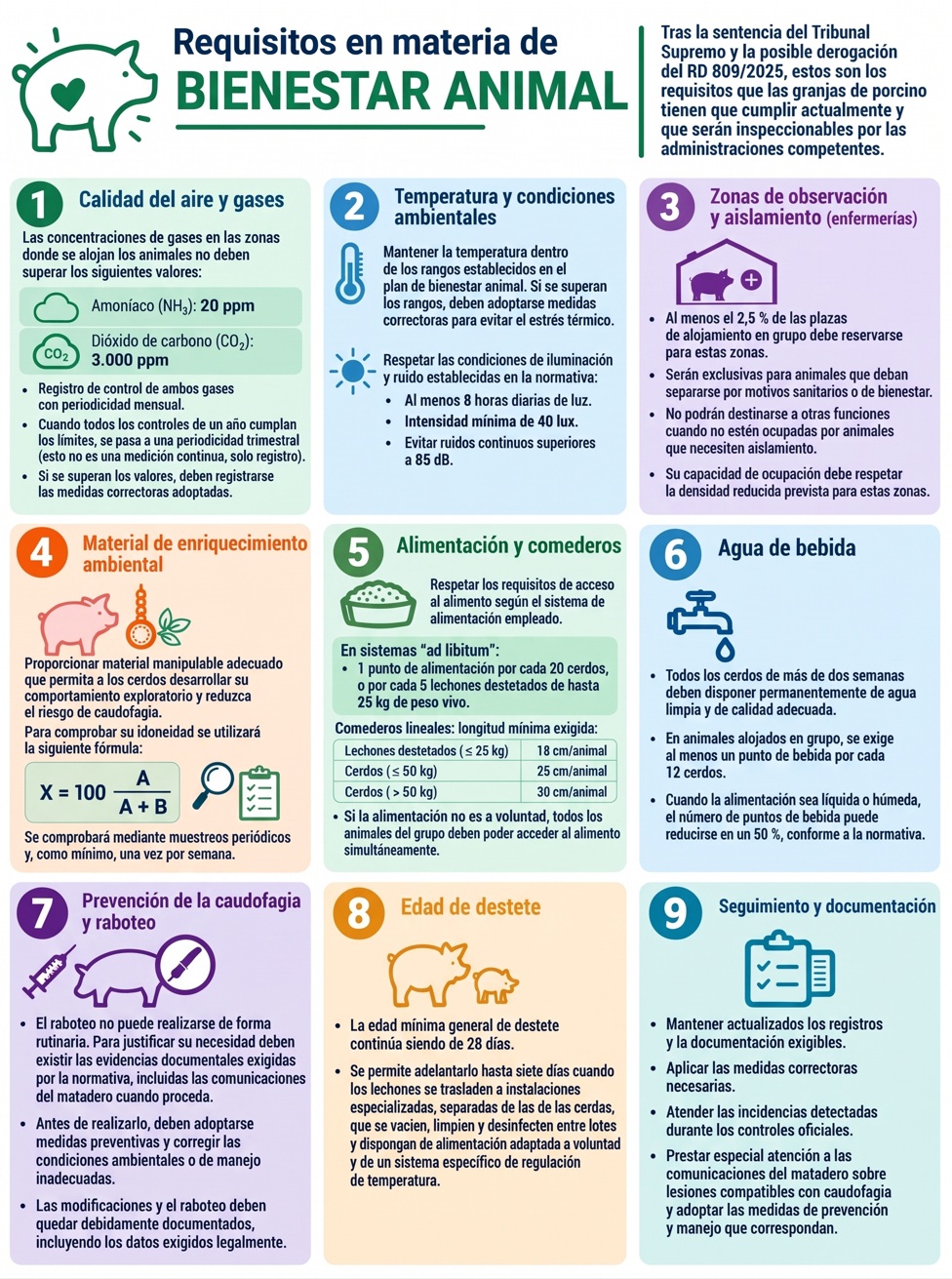
Air and gases, temperature, isolation pens, enrichment, feeding, water, tail biting, weaning and paperwork · Spanish-language graphic, tap to enlarge
Augan does it for you
Your sensors generate the report automatically
Install our NH₃ and CO₂ sensors and the system produces the periodic records with nothing for you to do. Always up to date, always ready for an inspection, with the full history if anyone asks for it.
Space per animal
Which densities apply now
There are no farm types left to declare and no different densities by type. With RD 809/2025 struck down, the reference is once again the original table in RD 1135/2002.
Unobstructed floor area per animal
Weaned piglets and rearing pigs kept in groups · RD 1135/2002, art. 3.1
| Live weight | Minimum area |
|---|---|
| Up to 10 kg | 0.15 m² |
| 10 to 20 kg | 0.20 m² |
| 20 to 30 kg | 0.30 m² |
| 30 to 50 kg | 0.40 m² |
| 50 to 85 kg | 0.55 m² |
| 85 to 110 kg | 0.65 m² |
| Over 110 kg | 1.00 m² |
Sows and gilts kept in groups: 2.25 m² per sow and 1.64 m² per gilt after service. In groups of fewer than 6 animals the area increases by 10%; in groups of 40 or more it may be reduced by 10%.
If you have been following the changes
The 85–110 kg finishing pig has been the flashpoint throughout. RD 159/2023 raised it to 0.80 m²; RD 809/2025 set it at 0.68 m² for Type 2 and 0.74 m² for Type 3.
Both regulations have fallen in court on the same grounds — an inadequate economic impact assessment — so the figure that applies is 0.65 m² again.
Before committing to an investment
This area has shifted three times in three years and may shift again. The consolidated BOE text may take a while to reflect the annulment, and Spain's Ministry of Agriculture already had a draft royal decree in the pipeline to repeal RD 809/2025 and give the sector legal certainty.
If you are designing, expanding or converting buildings, confirm the figures with your technical adviser or your regional authority before sizing anything. This page is informative and does not replace professional advice.
The annulment also opens the door to claiming state liability for the economic damage suffered while the annulled regulation was in force. If you invested to adapt, it is worth looking into.
Timeline of legal changes
The baseline pig welfare regulation
Sets the maximum gas levels inside the buildings, measured at the height of the animals' heads: 20 ppm NH₃ and 3,000 ppm CO₂.
Requires monthly monitoring records proving compliance with those values, with the option of moving to quarterly.
Enforceable on farms already in operation since March 2026, after the transitional period was extended from two years to three.
In force in this part
Farms sorted into 3 types
Sorted farms into Type 1, 2 and 3 according to tail docking and complementary welfare measures, with a different authorised density for each type.
Set 0.68 m²/animal for Type 2 and 0.74 m² for Type 3 in pigs of 85 to 110 kg, and required 5 fixed requirements plus 2 out of 5 optional ones to reach Type 2.
Entered into force on 9 March 2026.
Struck down in full
The Supreme Court annuls the RD 159/2023 densities
The Supreme Court annuls the density provision in the fourth final provision of RD 159/2023, which raised the minimum unobstructed floor area per head.
The reason: the administration did not adequately justify the economic impact of forcing farms to change their densities.
The rest of RD 159/2023 — gases, records, isolation pen — remains fully in force.
The Supreme Court strikes down RD 809/2025 in full
Judgment 1160/2026 upholds ARAPORC's appeal and declares RD 809/2025 null and void for a substantially inadequate economic impact assessment.
The three farm types and their densities disappear. On stocking density, the RD 1135/2002 table applies again.
The Court does not question the animal welfare objectives or the drive to end routine tail docking.
Where things stand
This page was last reviewed on 6 November 2026. Informative content prepared by Augan from the BOE and industry sources; it does not replace professional legal or technical advice.


